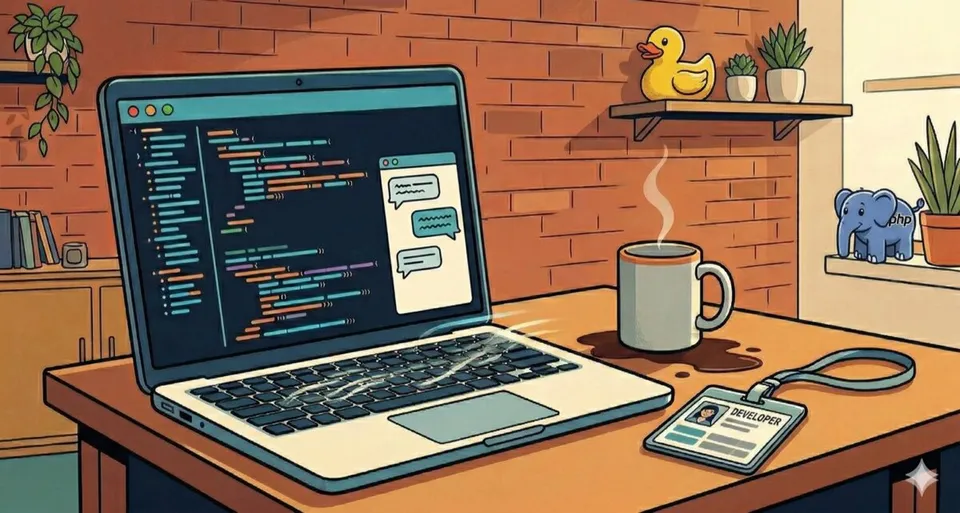
What if we no longer needed developers?
In the first article of this series, I shared my personal journey: from ChatGPT to Claude Code, how AI went from gimmick to development partner. Today, I want to step back and ask the question every developer should be asking right now: is our profession disappearing?
The fastest adoption in history
To grasp what’s happening, you need to look at the numbers. And the numbers are impressive.
Facebook took 4 and a half years to reach 100 million users. Instagram, 2 and a half years. TikTok, 9 months.
No technology has ever been adopted this fast. This adoption speed points to a real need.
Generative AI is fundamentally transforming the way we create, and we, developers, have front-row seats.
The cost of code has become nearly free
More and more developers report not writing a single line of code themselves anymore, and I’m one of them.
Let that sink in for a second.
What used to cost weeks of development now costs a few hours of conversation with an LLM. A feature that required a team of three developers over a sprint can now be prototyped in an afternoon by a single dev with AI assistance.
Code is no longer a scarce asset. It’s become accessible to anyone who can articulate what they want to build.
That’s a tough pill to swallow when you’ve spent 20 years honing your technical skills. But it’s the reality. The value no longer lies in “knowing how to code”. It’s shifting toward “knowing what to build and why”. And increasingly, “knowing how” as well.
AI still struggles with pure architecture design, the structural decisions that determine whether a project holds up in the long run. But it’s only a matter of time. Raw technical skill, the thing that used to define us, is no longer the limiting factor. Product vision, understanding business needs, the ability to steer AI toward the right solution — that’s what makes the difference now.
What if it’s a bubble?
OpenAI projects $14 billion in losses for 2026 and doesn’t expect to be profitable before 2029 or 2030. The company could run out of cash by mid-2027. Anthropic is on a more cautious trajectory, with breakeven expected in 2028.
Every request we send to these models potentially costs more than it generates. Current token prices are subsidized by funding rounds. We’re using computing power that is being sold at a loss.
So, is this sustainable? Honestly, nobody knows. If the bubble bursts, token costs could skyrocket overnight. The current business model rests on the promise that AI will become profitable enough to justify today’s investments.
My take? Make the most of this window. Not naively, but pragmatically. Right now, we have access to computing power and AI at a price that doesn’t reflect its real cost. This is the time to learn, experiment, and build skills that nobody can take away even if prices change.
Because even if tokens become ten times more expensive, AI isn’t going away. Models will become more efficient, costs will eventually come down structurally. But the transition could be brutal for those who haven’t made the shift.
The dark scenario: the profession disappears
In a few years, maybe even months, AI codes better than 90% of human developers. Not just the tedious tasks nobody wants to do. Complex architecture, performance optimization, security, debugging.
Companies realize they no longer need teams of ten developers. Two “AI pilots” are enough to produce the same output. Tech budgets shrink. Hiring collapses.
The traditional junior developer no longer has a way into the profession. How do you justify a first developer job when AI does the same work for a fraction of the cost? The traditional learning curve, where you learn by coding simple features under senior supervision, no longer exists.
And the senior developer who refuses AI? They become unemployable. Not because they’re bad, but because they’re ten times slower than their colleague who uses AI. All else being equal, raw productivity wins.
This scenario isn’t science fiction. The signals are already there. In France, developer job postings dropped 80% between 2023 and 2025. In the US, entry-level positions at the 15 largest tech companies dropped 25%. Companies are downsizing their tech teams by leaning on AI. The shift is underway.
What if it’s the opposite?
If the cost of code has become nearly free, it means time-to-market has shortened considerably. Thousands of products that were too expensive to build become viable. Small businesses that could never afford custom development can now consider it.
We’re not talking about less development. We’re talking about more development, everywhere, for everyone.
And who’s going to drive all that? People who understand technology, product, and AI all at once. Developers who no longer just write code, but orchestrate agents, design architectures, and translate business needs into technical solutions through AI.
A new profession is emerging. Some call it “AI product engineer”, others talk about “AI orchestrator”. The term isn’t settled yet, and that’s fine — we’re in the process of inventing it.
More products also means more maintenance, more evolution, more need for human vision and strategy. AI doesn’t replace judgment, nor domain expertise. And even less the ability to say “no, that’s not the right feature to build”.
In this scenario, the developer who has embraced AI ends up with a rare profile: ten times more productive, with product vision, and an understanding of both technical constraints and AI capabilities.
Where does that leave us?
The reality will probably land somewhere between both scenarios. As always with technological transformations, extreme scenarios never fully materialize.
What’s certain is that the profession is mutating. Xavier Leune talked about this in a talk I recommend (in French): professions don’t disappear, they transform. And those who come out on top are always those who embrace the transformation rather than fight it.
So what does that actually mean for us?
It means it’s time to redefine what makes us valuable. It’s no longer the ability to write a sorting algorithm or configure a Symfony service. It’s the ability to understand a problem and steer AI to solve it. It’s architectural vision, product sense, experience accumulated across dozens of projects.
Everything we’ve learned over 20 years doesn’t vanish. It changes shape. Debugging experience becomes the experience of validating generated code, architecture pattern knowledge helps guide AI. And the gut feeling of “this is going to break in production”? Still irreplaceable.
What I’ve chosen to do
For my part, I’ve decided to go for it. Not blindly, but I’d rather experiment now than be forced to adapt later.
This series of articles is my way of documenting this transformation in real time. Not with the comfortable hindsight of someone writing five years after the fact. Now, while it’s happening.
In the upcoming articles, I’ll get into the specifics: how I set up my environment, how I use Claude Code daily, how I built my own tools to push things even further.
But before the technical stuff, this reflection needed to happen.
We’ll always need developers. Just not the same ones as before.